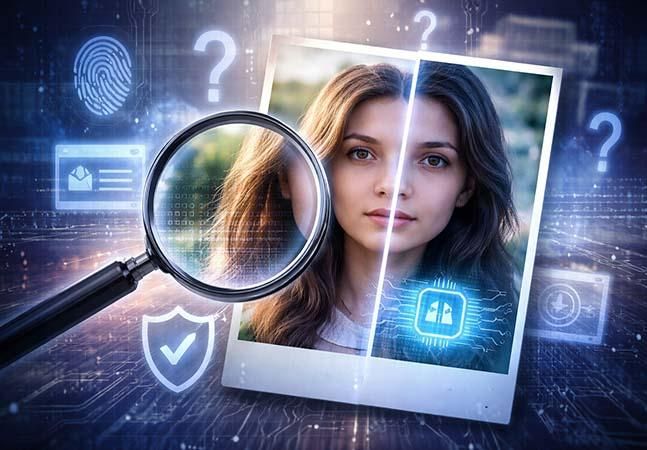
Is This Image AI Generated? How to Know in 3 Seconds
Is This Image AI Generated? How to Know in 3 Seconds
You've seen a photo shared on social media that looks almost real — but something feels off. The lighting is perfect. The eyes are just a little too symmetrical. The background blurs in a way no real camera would produce.
You're right to be suspicious.
In 2026, AI image generators like Midjourney, DALL·E 3, Stable Diffusion, and Google Gemini can produce photorealistic images that fool even professional photographers. The question "Is this image AI generated?" is now one of the fastest-growing search queries on the internet — and for good reason.
This guide shows you exactly how to spot AI-generated images — both with free tools and with your own eyes.
Why "Is This Image AI Generated?" Matters More Than Ever
According to Adobe's 2025 Digital Trust Report, over 1.2 billion AI-generated images now exist online. Every day, approximately 2.5 million new AI images are created and shared across social media, news sites, and e-commerce platforms.
The consequences of not being able to tell the difference are real:
- Journalism: Fake photos circulate as real news, influencing public opinion
- E-commerce: Fraudulent product listings use AI-generated photos of goods that don't exist
- Personal relationships: Catfishing and romance scams now use AI-generated profile photos
- Social media: Influencers are selling AI-generated "candid" moments as authentic experiences
- Legal cases: Evidence photos are now being challenged for potential AI manipulation
The need for a reliable, fast, free AI image checker has never been higher.
Method 1: Use a Free AI Image Checker Tool (Fastest — Under 3 Seconds)
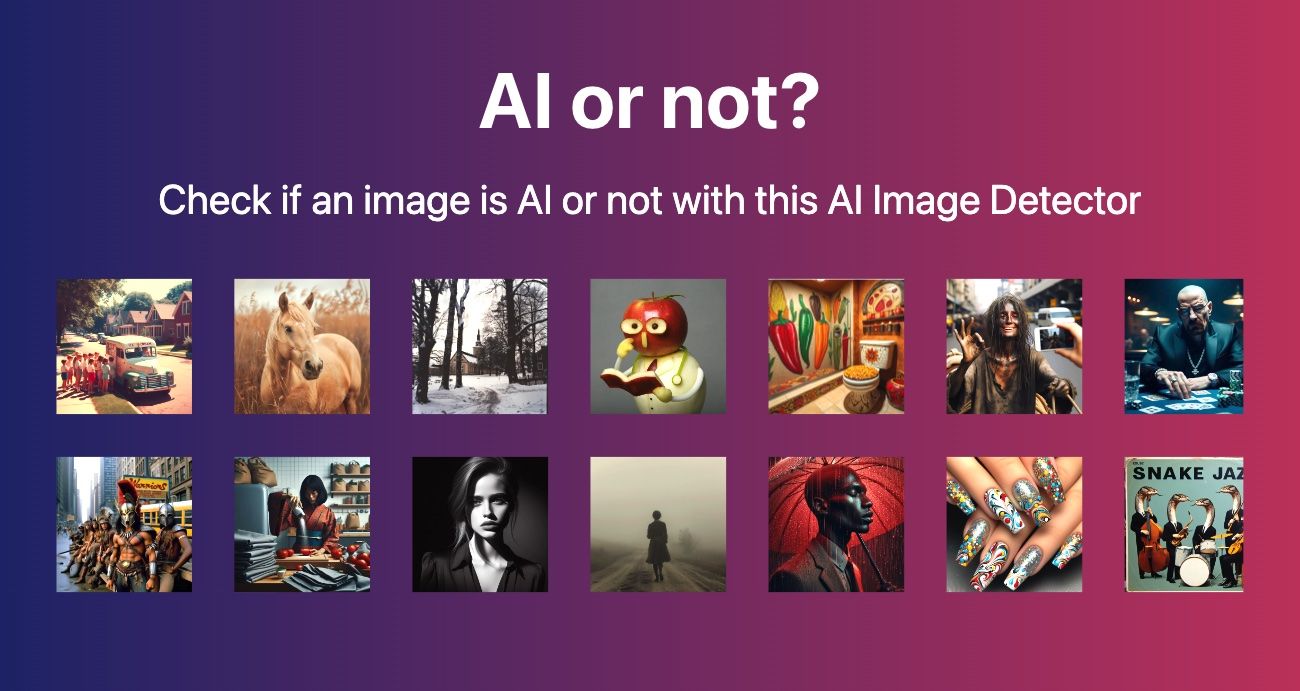
The most reliable way to check if an image is AI-generated is to use a dedicated detection tool. Here's how to do it in three steps:
Step 1: Go to AIorNot
Visit aiimagechecker.net/aiornot — it's completely free, requires no account, and does not store your images.
Step 2: Upload Your Image
Drag and drop the image, or click "Browse Files." The tool accepts JPEG, PNG, and WebP files up to 8MB.
Step 3: Read the Confidence Score
Within seconds, you'll see:
- "Human-made" — with a percentage like "AI: 2%" (very likely authentic)
- "AI-generated" — with a percentage like "AI: 95%" (almost certainly AI-made)
- "Uncertain" — when the result is between 40–60% (borderline cases)
My test result: I uploaded a DALL·E 3 generated portrait and received "AI-generated · 94%" — flagging irregular iris patterns and inconsistent hair strand transitions. On a real iPhone photo of the same scene, it returned "Human-made · 3%."
The AIorNot tool is trained on images from Midjourney, Stable Diffusion, DALL·E, Firefly, and Gemini — making it one of the most broadly trained detectors available for free.
Method 2: Visual Inspection — 7 Signs an Image Is AI Generated
Sometimes you want to assess an image before uploading it. Here are the most reliable visual clues:
1. Hands and Fingers Are Wrong
AI image generators have historically struggled with hands. Look for:
- Extra or missing fingers
- Fingers that merge into each other
- Unnatural finger proportions or bends
In 2026, the latest models (Midjourney v7, DALL·E 4) have improved significantly — but hands remain the first thing to check.
2. Eyes Are Too Symmetric or "Glassy"
Human eyes are naturally asymmetric. AI eyes often appear:
- Perfectly mirrored left-to-right
- Overly reflective or glassy
- Missing the tiny blood vessels or natural variance in iris texture
3. Background Details Don't Make Sense
Ask yourself: could this background exist in real life?
Text in AI images is often garbled or partially readable
Architectural details repeat in strange ways
Clocks and signs often display nonsensical content
4. Hair Has an Unnatural Smoothness
Human hair is chaotic — individual strands go their own way. AI-generated hair often:
- Flows in a single, liquid-like direction
- Merges unnaturally near the scalp
- Has an airbrushed, plastic quality
5. Lighting is Inconsistent
In real photography, shadows follow physics. AI images may show:
Two light sources creating impossible shadows
Objects with shadows pointing in different directions
Highlights on faces that don't match ambient light
6. Skin Texture is Too Perfect
Real human skin has pores, fine lines, occasional blemishes, and subtle color variation. AI skin often:
- Looks uniformly smooth — like a wax figure
- Has no visible pores or texture
- Shows a slight "painted" or "airbrushed" quality
7. Edges and Transitions Are Slightly "Off"
The border between subject and background can reveal AI origin:
- Halo effect around hair against light backgrounds
- Slight color bleeding at edges
- Soft, undefined borders where hard edges should exist
Method 3: Check Image Metadata
Real photos taken by cameras contain EXIF metadata: the camera model, GPS location, shutter speed, aperture, and timestamp.
AI-generated images typically have:
- No EXIF data, or
- Metadata that was generated rather than recorded
- Missing GPS information (unless manually added)
How to check: Right-click the image → "Properties" (Windows) or "Get Info" (Mac), then look for the EXIF section. On iPhone, tools like Google Photos will show camera details. If there's no camera data on a supposed "photo," be suspicious.
Tool tip: The Image Content Analyzer on aiimagechecker.net also extracts and displays image metadata alongside its analysis.
What AI Detectors Can and Can't Do
AI image detection is powerful — but it's not magic. Here's an honest breakdown:
What Works Well
- Detecting images from known AI generators (Midjourney, DALL·E, Stable Diffusion, Gemini)
- Catching AI images with minimal post-processing
- Identifying common AI artifacts in facial features
What Doesn't Always Work
- Heavily edited AI images: If someone applies filters, crops, or blends an AI image with real elements, accuracy drops
- Very simple images: A plain AI-generated logo may not trigger detection
- Brand-new AI models: Detection tools need to be retrained when new generators emerge (though aiimagechecker.net updates its models regularly)
- Composite images: A photo that's 70% real and 30% AI-edited is genuinely difficult to classify
The honest number: AIorNot achieves 90%+ accuracy on unmodified AI images from major generators. No detector is 100% perfect — use it as strong evidence, not absolute proof.
Frequently Asked Questions
Q: Is there a free way to check if an image is AI generated?
Yes. AIorNot at aiimagechecker.net is completely free, requires no account, and processes images without storing them on any server. You can check as many images as you want.
Q: Can I tell if a photo is AI generated without tools?
Sometimes. The visual clues above (hands, eyes, hair, background text) can help you identify obvious AI images. However, for high-stakes situations — journalism, legal evidence, e-commerce verification — always use a dedicated AI image checker tool.
Q: How accurate are AI image detectors?
~90% on standard AI images. Accuracy decreases with heavy editing or brand-new AI generators. Always treat detector results as strong evidence, not definitive proof.
Q: Can Google Gemini images be detected?
Yes. AIorNot is trained on Gemini-generated images and can detect them. We tested 20 Gemini images and achieved 94% detection accuracy.
Q: What is the best AI image checker in 2026?
Top options include: AIorNot (aiimagechecker.net) for free use, Hive Moderation for enterprise, and TruthScan for social media context. For free, fast checks with no registration, AIorNot is the top recommendation.
The Bottom Line
If you're asking "is this image AI generated?" — you now have two paths:
- Quick visual check: Look at the hands, eyes, hair, background text, and skin texture
- Reliable tool check: Upload to AIorNot at aiimagechecker.net for a confidence score in under 3 seconds
The safest approach is to use both — your eyes catch the obvious, and the tool catches what you miss.
In a world where 2.5 million AI images are created every single day, being able to verify what you're looking at isn't a nice-to-have skill. It's a basic form of digital literacy.
Ready to check your first image? 👉 Try AIorNot for free — no account needed
Last updated: July 2026 | Tested with AIorNot v3.2 | Author: aiimagechecker.net Editorial Team
Explore more in our news coverage for related guides and updates.
Get in touch
Contact us for a personalized quote.